

Biology exams love to ask about cell types, and fungi are an easy place to slip. If you’ve looked up fungi prokaryotic or eukaryotic, here’s the answer: fungi are eukaryotic. Their cells have a true nucleus and other membrane-bound parts, unlike bacteria.
What eukaryotic means
A eukaryotic cell keeps its DNA inside a nucleus, which is wrapped in a membrane. It also has organelles such as mitochondria. Animals, plants, fungi and protists are all eukaryotes. Prokaryotes, like bacteria and archaea, have no nucleus, and their DNA floats freely in the cell.
Proof that fungi are eukaryotes
If you look at a fungal cell under a microscope, you’ll find several clear signs.
- A true nucleus. The cell’s DNA is stored in a membrane-bound nucleus.
- Mitochondria. These organelles produce energy for the cell.
- Internal membranes. Fungi have structures like the endoplasmic reticulum and the Golgi apparatus.
- Larger cells. Fungal cells are generally much larger than bacterial cells.
What makes fungi different from plants and animals
Even though fungi are eukaryotes, they aren’t plants or animals. They form their own kingdom. Their cell walls are made of chitin, the same tough material found in insect shells. Plants use cellulose instead. Fungi also don’t make food from sunlight, and they don’t eat by swallowing. Instead, they release enzymes into their surroundings and absorb the digested nutrients.
Why the confusion happens
Fungi sometimes get lumped in with bacteria in everyday conversation, because both cause things like mold and infections, and both are tiny. Yeasts, in particular, are single-celled, so people assume they must be simple like bacteria. But yeast cells have a nucleus and organelles, so they’re eukaryotic. Being small or single-celled doesn’t make an organism prokaryotic.
A few examples
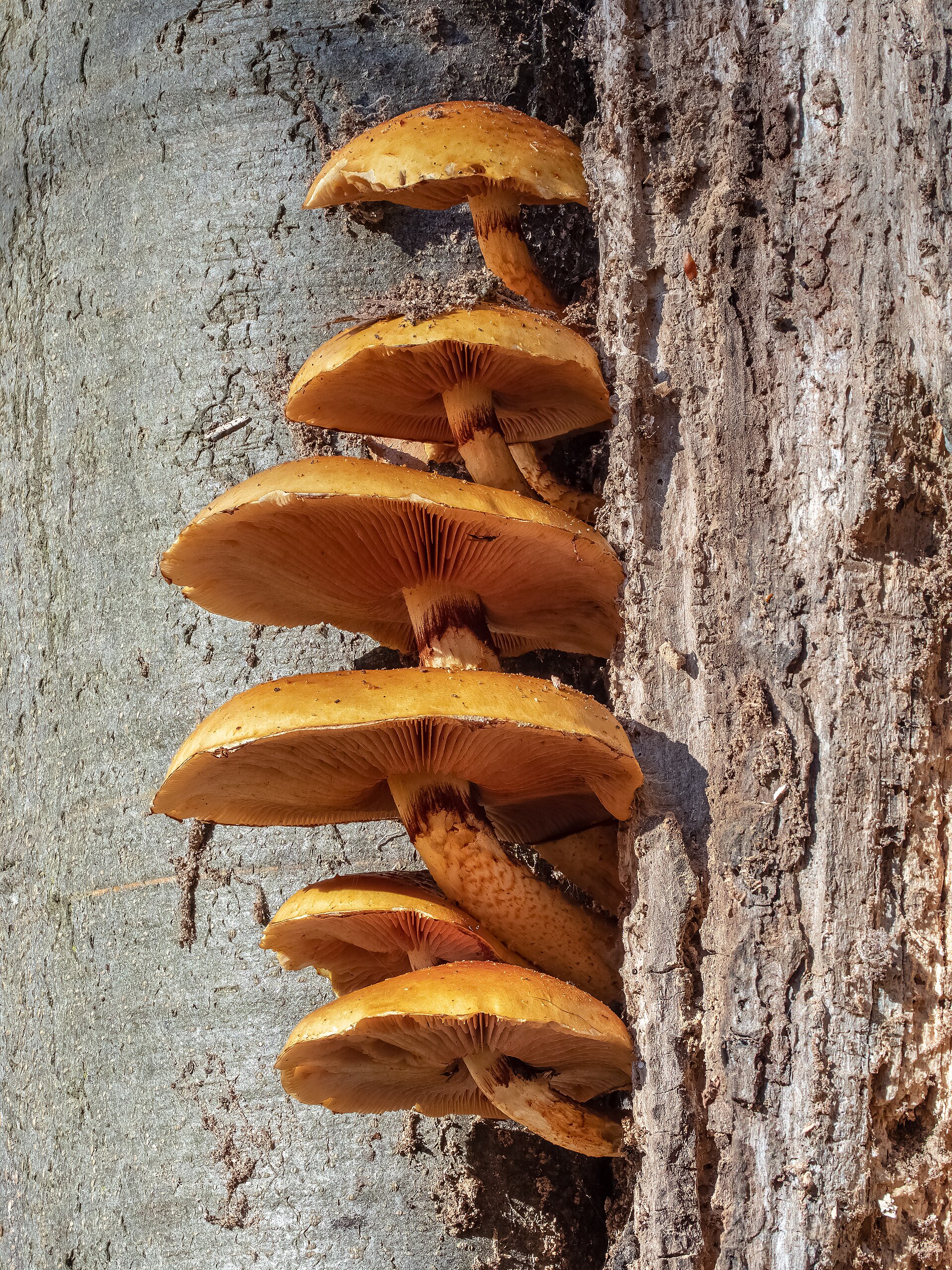
Baker’s yeast is a single-celled eukaryote used in bread and beer. Mushrooms are multicellular fungi, and the part you eat is the fruiting body. Bread mold grows as a web of threads called hyphae. All three have eukaryotic cells, even though they look and act quite differently.
A quick comparison
- Bacteria: prokaryotic, no nucleus, cell wall made of peptidoglycan.
- Fungi: eukaryotic, nucleus present, cell wall made of chitin.
- Plants: eukaryotic, nucleus present, cell wall made of cellulose.
Why it matters in medicine
Because fungi are eukaryotes, they’re biologically closer to us than bacteria are. That makes fungal infections harder to treat. Antibiotics target bacterial features that fungi don’t have, so they don’t work on fungi. Doctors use antifungal medicines instead, and these must be chosen carefully so they hurt the fungus without harming human cells too much.
What about slime molds and other odd cases?
Some organisms, like slime molds, used to be grouped with fungi but are now classed elsewhere because of how they’re built and how they reproduce. It’s a reminder that classification changes as scientists learn more. For fungi proper, the eukaryotic label has never been in doubt, and DNA studies show they’re actually closer relatives of animals than of plants.
Memory trick for exams
Think of “eu” as “true,” as in a “true nucleus.” If a cell has one, it’s eukaryotic. Fungi have one, so they’re eukaryotes. For other quick biology explainers in plain language, compairro.com keeps short answers that are easy to scan before a test.
If you want to see the difference for yourself, compare a yeast cell and a bacterium in a microscope image. The yeast cell is visibly bigger, and a darker, rounded nucleus stands out inside it, while the bacterium shows no such structure at all.
The short answer
Fungi are eukaryotic. They have a nucleus, organelles and chitin cell walls, which sets them apart from bacteria. Whether they’re single-celled like yeast or multicellular like mushrooms, the answer stays the same.
